
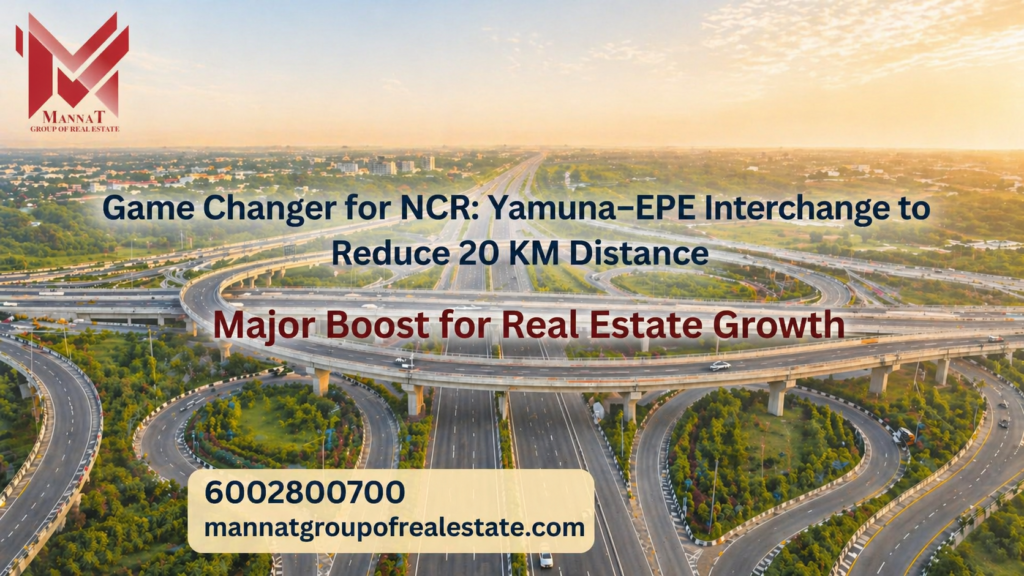
Game Changer for NCR: Yamuna–EPE Interchange to Reduce 20 KM Distance Major Boost for Real Estate Growth
Introduction
If you’ve been tracking development around Noida and the Yamuna Expressway, this update is worth paying attention to. A long-awaited interchange connecting the Yamuna Expressway and the Eastern Peripheral Expressway is finally nearing completion and is expected to open by the end of June or sometime in July.
At first glance, it may sound like just another road project—but it’s much more than that. This connection is going to change how people move across NCR, especially for those traveling between western UP, Haryana, and the upcoming airport zone. And wherever connectivity improves, development usually follows.
Project Overview
The plan for this interchange goes back to 2019, when authorities began focusing on improving access to the upcoming Noida International Airport. Like most large infrastructure projects, it didn’t move as smoothly as expected in the beginning. Land-related issues and the COVID phase slowed things down considerably.
Now, with the National Highways Authority of India handling the construction, the project is finally in its last phase. The interchange spreads across roughly 48 hectares and includes eight loops designed for smooth entry and exit from both expressways. Most of the heavy work is already done, and what remains now is the finishing layer and final touches before opening it for public use.
What’s the Problem Right Now?
At the moment, switching between these two expressways isn’t as easy as it should be. If you’re coming from one and need to get onto the other, you have to take a detour via Sirsa, pass through Pari Chowk, and then reconnect through Zero Point.
On paper, it may not sound like a big deal—but in reality, it adds close to 20 extra kilometers to your journey. During busy hours, this stretch gets crowded, and what should be a smooth drive often turns into a slow, frustrating one. For daily commuters and transport vehicles, this has been a consistent pain point
What Changes Once It Opens?
The moment this interchange becomes operational, travel between the two expressways will become direct. No more unnecessary detours, no more entering city traffic just to switch routes. That alone will cut down nearly 20 kilometers from the journey.
But the benefit isn’t just about distance. Travel time will become more predictable, and congestion around key areas—especially Pari Chowk—is expected to ease. Another big advantage is airport access. Reaching the Noida International Airport area will become quicker and more convenient, which is a big plus not just for travelers but also for businesses operating nearby.
Who Gains the Most from This?
The impact of this project won’t be limited to just Noida or Greater Noida. Cities like Greater Noida, Ghaziabad, and Meerut will see much smoother connectivity towards the Yamuna Expressway.
At the same time, people coming from Haryana will be able to access this route without dealing with inner-city traffic. Even those traveling longer distances—towards Agra, Mathura, or Lucknow—will notice a more seamless journey
What Does This Mean for Real Estate?
Rising Demand Along Yamuna Expressway
In real estate, connectivity is everything. The easier it is to reach a location, the more attractive it becomes. With this interchange in place, areas along the Yamuna Expressway are naturally going to draw more attention—from both buyers and investors.
Locations closer to the airport and major road networks will likely see the most activity, simply because they offer better accessibility and future growth potential.
Property Prices Are Likely to Move Up
There’s a clear pattern in how real estate behaves around infrastructure upgrades. Once connectivity improves, prices don’t stay stagnant for long. Initially, you see a spike in interest, and over time, that turns into steady price appreciation.
The same trend is expected here. As more people start looking at this region seriously, property values along the expressway could gradually move upward.
YEIDA Sectors Get a Push
For sectors developed under YEIDA, this is a strong positive. Direct connectivity to both major expressways makes these areas far more practical for living as well as investment.
Better roads mean better livability. And with the airport and industrial development coming up nearby, these sectors are likely to see more residential projects, along with increasing rental demand in the future.
Boost for Industrial & Commercial Activity
Improved connectivity isn’t just good for residents—it’s equally important for businesses. Faster movement of goods reduces transportation costs, which is a big factor for industries and logistics companies.
As a result, more warehouses, logistics parks, and commercial setups are expected to come up in this belt. And wherever business activity grows, demand for commercial real estate follows.
A Clear Growth Corridor in the Making
When you combine an expressway, a peripheral highway, and an international airport in one region, the direction of growth becomes quite clear. The Yamuna Expressway belt is gradually turning into one of NCR’s most promising development corridors.
This kind of infrastructure mix tends to attract not just investors, but also long-term development—residential, commercial, and industrial.
Is This the Right Time to Invest?
From an investment point of view, timing matters a lot. Right now, prices in this region are still relatively reasonable compared to more developed NCR areas. But with projects like this nearing completion, that may not remain the case for long.
For those looking at long-term gains, plots could be a strong option. On the other hand, commercial investments might start generating rental opportunities as business activity increases.
Conclusion
The Yamuna–EPE interchange might look like just another infrastructure update, but its impact goes much deeper. It simplifies travel, reduces congestion, and improves overall connectivity across key regions.
More importantly, it strengthens the case for the Yamuna Expressway as a serious growth zone. As infrastructure continues to develop, this entire belt is likely to see steady progress in both livability and real estate value.
For anyone keeping an eye on property investment, this is one development you shouldn’t ignore.
FAQs
Yes, and quite noticeably. Right now, a lot of vehicles passing through Pari Chowk aren’t even headed there—they’re just using it to switch between routes. Once the direct interchange opens, that unnecessary movement will reduce. Over time, this should ease congestion and make daily traffic a lot smoother in that area.
The biggest advantage here is simplicity. Instead of entering city roads and dealing with signals or traffic, people will be able to take a more direct route—especially those coming from Haryana or western UP. This means reaching the Noida International Airport will be quicker, more predictable, and far less stressful.
The areas closest to the expressway will obviously feel the impact first—especially the Yamuna Expressway belt and nearby YEIDA sectors. Apart from that, places like Greater Noida and surrounding regions will also benefit because of smoother connectivity. In general, wherever travel becomes easier, both livability and property demand tend to improve.
No one can predict exact numbers, but the pattern is quite clear. Whenever connectivity improves, more people start showing interest in that location. That increased demand usually pushes prices upward over time. So while it may not happen overnight, steady appreciation is definitely a strong possibility here.
Many investors prefer entering at a stage like this—when development is visible but prices haven’t fully peaked yet. The region is still evolving, especially with the airport and infrastructure projects coming up. So if you’re looking at long-term gains, this phase could offer a good balance between affordability and future growth.
Right now, switching between the two expressways involves going through city areas, which slows things down. The new interchange changes that completely by offering a direct connection with dedicated loops. In simple terms, it removes the unnecessary city detour and makes the entire journey much more seamless
Yes, and probably quite significantly. For businesses, time is money—especially in logistics and transportation. Better roads mean faster movement of goods and lower costs. Because of this, you can expect more warehouses, logistics hubs, and commercial activity to develop around this corridor